Pages

Thursday, March 3, 2022

Writing in the Margins with Hypothes.is

This post was originally published at BCCampus as a part of the FLO Tech Tool Tip for the month of February.

We are all too familiar with marking up books with highlighter pens and adding hand-scribbled notes along the margins. If your books were hand-me-downs like mine, then you’ve probably already seen the power of collaborative annotation.

But how do you take notes while reading websites, blogs, and online articles? Perhaps you hand-write in a physical notebook but then have to capture the related context too. Or you type notes in a notes app or a Word document and save them on your mobile phone or computer. Maybe you bookmark the hyperlink only to never see it again.

What if you had a tool that would allow you to mark directly on the webpage and embed your notes right into the particular passage just like you did in your books? What if you could also make it viewable for others to add or respond to and have conversations about your notes within the text? 

Hypothes.is can help you do that! 

Hypothes.is (Hypothesis) is an online social annotation tool you can use to annotate websites, blogs, and online articles and journals. You can use it as a private note-taking tool or create groups to work collaboratively to annotate a webpage or any online text. Hypothesis is a free, open-source tool. Once you create an account, you can download a Google Chrome browser extension and annotate any webpage or online text. You can annotate privately or publicly and create groups for friends, co-workers, or course participants to annotate collaboratively. 

To get started with Hypothesis:

  1. Create an account
  2. Install the Chrome extension, or install the Hypothesis bookmarklet if you are using a browser other than Chrome. 
  3. Start annotating!

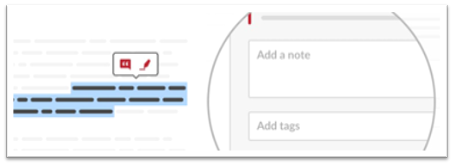
Using Hypothesis, you can highlight text, which is the digital equivalent of swiping a yellow marker over a passage of text. You can annotate text, which is the digital equivalent of a marginal note, and you can reply to an existing annotation and add your comments or feedback. 
Source: web.hypothes.is

Annotations support and enhance individual reading by helping the reader be more present in a world of online distractions. You can interpret the text based on your individual context and purpose and highlight sections of the text for future reference or reading. Annotating can help you stay focused on the text, and annotations “anchor” the discussion right into the text. If you open it up and make it collaborative, by reading the annotations by others, you can interpret the text from different perspectives. The real value of social annotation is that it can help you recognize opposing views or understandings of the text. This creates an opportunity to engage in critical reading and deeper thinking. 

I have used Hypothesis to create opportunities for discussion on my blog posts and look forward to using it in courses I teach. But you can use it in many different ways, including for taking personal notes, course instruction, or in the workplace to collaboratively review and annotate work documents. 

If you are teaching a course, some strategies for using Hypothesis are:

  • Inviting participants to review course curriculum, study notes, and reading materials and annotate parts of the text that are confusing or unclear
  • Pre-populating the reading materials with annotations tagged as “Instructor Questions” and encouraging participants to respond to the questions and share ideas as they read
  • Asking participants to create discussion questions by annotating parts of the text and inviting peers to share opinions 

Annotations using Hypothesis “makes reading visible, active and social for students.” In addition, social annotation tools like Hypothesis support Universal Design for Learning (UDL) principles and help build “learner choice and voice” into the design of learning by providing multiple options for student engagement, representation, and action and expression.

In “From the Margins to the Center: The Future of Annotation,” scholars Joanna Wolfe and Christine Neuwirth identify four primary functions of text annotations, including: 

  • Facilitating reading and later writing tasks, which include annotations that support reading for both personal and professional purposes
  • Eavesdropping on the insights of other readers, which involves sharing of annotations
  • Providing feedback to writers or promoting communication with collaborators, which can include personal, professional, and education-related feedback
  • Calling attention to topics and important passages for which scholarly annotations, footnotes, and call-outs often function (Wikipedia)

Are you ready to “write in the margins” using Hypothesis? Here’s a short video that can help you get started! 

Did you know the annotations made in the margins of a book or any other document are called marginalia? The scholia on classical manuscripts are the earliest known form of marginalia.

Monday, January 31, 2022

Needs Assessment Versus Needs Analysis

The terms, “Needs Assessment” and “Needs Analysis” are often used interchangeably. How are they similar? What makes them different? 

This is a question that comes up often in my conversations with both new and experienced instructional designers. There are many views and perspectives about the correct answer. It doesn't help that we have different types of analysis including performance analysis, task analysis, context analysis, audience analysis, etc. 

So, here's my response. 

Given a business problem or an opportunity:
Needs Assessment is the identification of the gap that exists between the current state and the desired state.
 
Needs Analysis (or Gap Analysis) is the identification of the root cause of the gap. 

When applied to training, we also see it being referred to as Training Needs Analysis (TNA). In the context of TNA, there is a performance gap in terms of the underlying knowledge, skills or practice.

But a performance gap may also occur due to poor environment, inadequate processes, lack of tools or resources, lack of motivation, absence of performance standards, etc. Training is not the right choice given these gaps and that's when one would use Performance Analysis. The scope of Performance Analysis is much wider than that of Training Needs Analysis.

Both Training Needs Analysis and Performance Analysis require gathering information about the learners/employees (Audience Analysis), the tasks/work they are expected to perform (Task Analysis), and the context in which the task/work is performed (Context Analysis).

Clear as mud? :)

Sunday, December 12, 2021

Adopting an Anti-Racist Pedagogy in Teaching and Learning

I am always trying to find the 'intersections' in which we exist and become more 'human'. In learning more about how we learn, I am able to find things that truly unify us. In addition, using a diversity, equity and inclusion lens on my own work in the practice of instructional design has aided in that introspection and reflection. But this year, I have also made a conscious effort to think about and commit to extending this individual reflection and learning collaboratively. 

My 'formal' learning journey started in March 2021 with reflecting on "Integrating Human Rights into Learning Design" (Webinar by I4PL). In May, I undertook the Universal Design for Learning (UDL) FLO course by BCcampus. In July, I attended the "The Accessible & Inclusive Design Conference 2021" by The Training, Learning, and Development Community (TLDC). Through July, Aug, Sep and Oct, I applied UDL principles in a course I was teaching at UVIC, and in November, I led a session for I4PL on UDL in the workplace and shared my experience of incorporating the UDL strategies in an Instructional Design course I was teaching at UVIC. Here's December and I just completed a FLO course with BCCampus to learn how to incorporate an anti-racist pedagogy into my teaching and consulting practice.

At the end of the FLO course, I had to share a reflection on some of the principles that might guide me in my anti-racist work and in my goal to adopt an anti-racist pedagogy in teaching and learning. This is what I shared with my peers:
------

As I begin to think about my principles for anti-racist work, it is important for me to ask myself two questions: what is motivating me to be anti-racist? And why am I doing this work?
As an educator and a learning experience designer, it is critical that I reflect on my own practice of teaching and learning. I came to the FLO course to learn more about anti-racist teaching practices and associate myself with a community that wants to make its anti-racists efforts more visible.

I am inspired by Kyoko Kishimoto who shares that “Anti-racist pedagogy is not about simply incorporating racial content into courses, curriculum, and discipline. It is also about how one teaches, even in courses where race is not the subject matter. It begins with the faculty’s awareness and self-reflection of their social position and leads to the application of this analysis not just in their teaching, but also in their discipline, research, and departmental, university, and community work. In other words, anti-racist pedagogy is an organizing effort for institutional and social change that is much broader than teaching in the classroom” Anti-racist Pedagogy: from Faculty’s Self-reflection to Organizing within and beyond the Classroom”.

Given that definition of anti-racist pedagogy, some of the principles that I think will guide me in my learning journey are:

1. I must intentionally prioritize anti-racist work by allocating the time and resources it needs. I must consciously make a choice to offer safe spaces within and outside my courses and make an ongoing commitment to engage from a strength-based perspective rather than a deficit-based perspective. I will be guided by this statement by Dr. Ibram X. Kendi who says, “Anti-racist is a verb, defined by the action one is taking.”

2. I must accept my prejudices and recognize my biases and work towards reducing/ eliminating those. This is a journey that I must undertake which will no doubt push me into an uncomfortable zone. But beyond that discomfort lies true learning and growth. Given that, being an anti-racist to me means taking an active stance and moving along the continuum of fear, learning and growth.

Created by Andrew M. Ibrahim MD, MSc, a House Staff Surgeon at the University of Michigan and Chief Medical Officer at HOK, this image is free to use, copy and share.

3. In one of the course resources, Jessica Rowland Williams highlighted how institutions can harness technology to address systemic inequities through digital learning but also spoke about various myths related to digital environments and racism. Given that, I must strive to create anti-racist equity in digital learning environments by critically evaluating the curriculum for lack of inclusiveness and by understanding the impact of tools and technology on different student groups. In doing so, I hope to raise accountability for the digital learning provider(s) to build more equitable solutions for all.

Through this course, I have found that being an anti-racist appears different for white people and people of color. I find myself questioning how I may have internalized racism (Singh, A. 2019) and how as an anti-racist, I stand united in solidarity with other people of color.

“We all have a sphere of influence. Each of us needs to find our own sources of courage so that we can begin to speak. There are many problems to address, and we cannot avoid them indefinitely. We cannot continue to be silent. We must begin to speak, knowing that words alone are insufficient. But I have seen that meaningful dialogue can lead to effective action. Change is possible.” ― Beverly Daniel Tatum